Block Blast: that fits. But should it go there?
A piece fits, a line disappears, and everything looks fine. Two moves later, the square has nowhere to go. Block Blast is a useful study in how a tiny board turns today’s tidy solution into tomorrow’s problem.
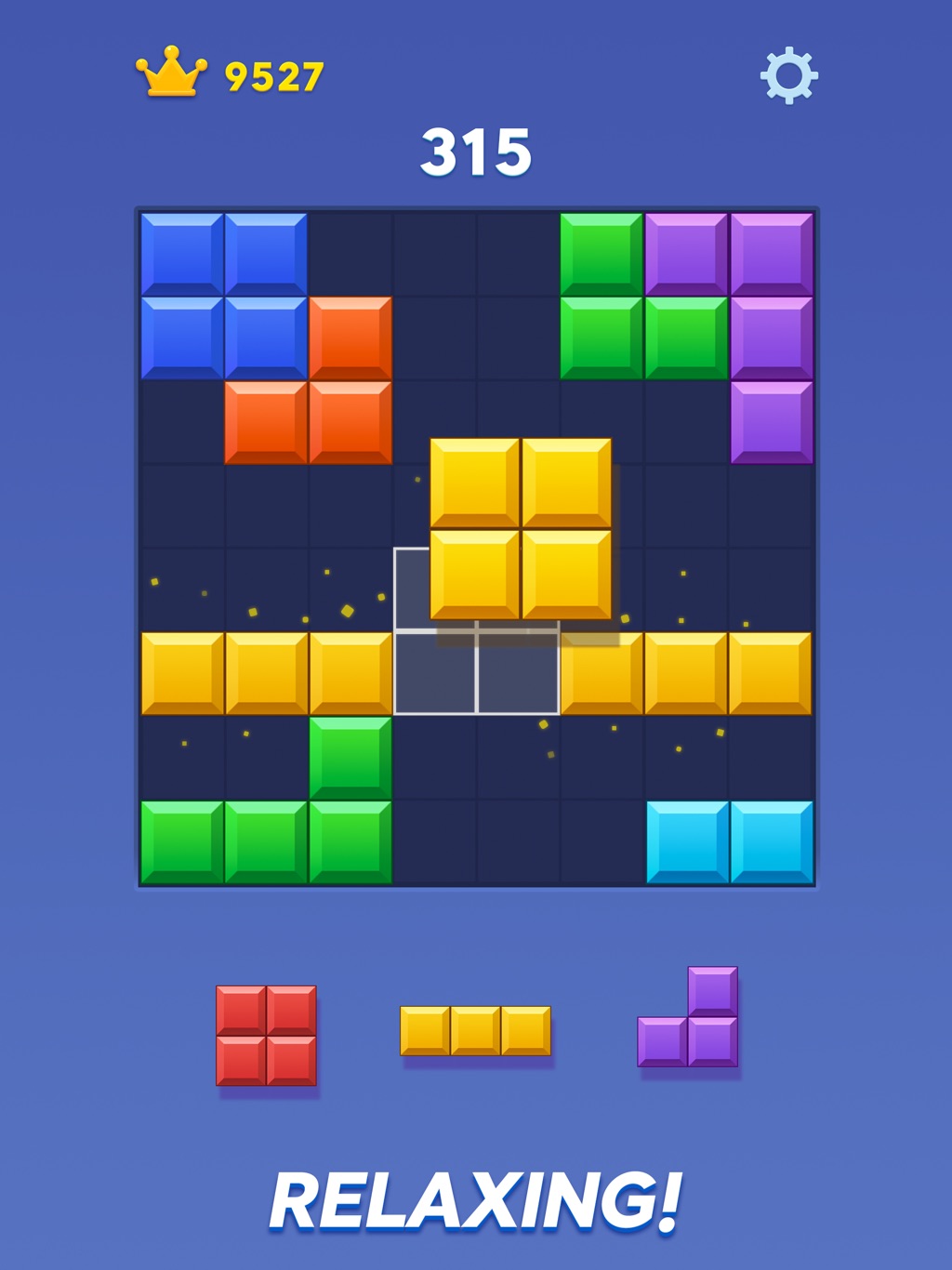
Publisher promotional artwork. The hovering square and outlined destination make the intended action visible; the board’s remaining openings carry the next decision. The marketing wording belongs to the source image.
In this guide
The core placement-and-clearing puzzle, using the publisher’s documented rules and credited genre analysis. Modes and offers can change. Our six-by-six parcel puzzle has an authored board and fixed tray; it does not reproduce Block Blast’s scoring or undisclosed piece-selection system.
- Made by
- Hungry Studio
- Looking at
- Mobile block puzzle; core placement and line-clearing rules
- Design question
- Spatial optionality, planning horizons, feedback, and puzzle fairness
An empty square is not the same as room
Hungry Studio describes Block Blast as placing shapes on an eight-by-eight board and clearing complete rows or columns. Those rules are short. The consequences are not. Every placement changes which shapes can fit afterward.
Imagine two shelves with eight empty squares each. One has a clear two-by-four rectangle. The other has eight isolated gaps. Their capacity is identical if you count squares. Their usefulness is very different if you are carrying a two-by-two parcel.
That distinction is the heart of this study. Space has shape. A move can consume little area and destroy an important opening. Another can fill more squares while completing a line that restores a valuable region. “Keep the board empty” is a reasonable instinct, but a poor complete strategy.
For a designer, this is a satisfying source of depth because the consequences live in a shared visual object. You can point at the gap, try a piece, and explain the failure. There is no need to invent a complicated vocabulary before players can begin making interesting mistakes.
Take away the falling piece. Keep the pressure.
Deconstructor of Fun’s genre analysis places Block Blast within a broader shift from falling-block timing toward deliberate placement and short sequences of pieces. That is a useful starting lens. Our focus here is the design of the individual decision and how a maker can test it.
Removing an execution deadline does not remove consequences. In an untimed packing puzzle, each action spends room. The board waits for you, but it does not forgive the placement simply because you considered it for a long time.
Compare two original prototypes. In one, a parcel drops every second and you steer it. In the other, you inspect three parcels and choose where to put each. Both use the same shapes. The first asks for quick recognition and control. The second gives you time to form a sequence, and can therefore hold you responsible for considering one.
The pleasant surprise is how little machinery that second version needs. A visible tray can create a planning horizon without a long tutorial or a huge level. The player can think beyond the next action because the relevant future is already on the screen.
Be careful with the label “relaxing.” A slow interface can still create frustration if mistakes are hard to diagnose or if the player believes the game changed the rules. Relaxed timing is one property. Trust, recoverability, and emotional tone are separate design jobs.
Play it: three parcels, one crowded shelf
This original experiment gives you a long parcel, a tall parcel, and a square parcel. Select one, then tap the board square where its upper-left corner should go. Full rows and columns clear simultaneously. There is no rotation and no timer.
Try fitting all three before opening the explanation. Undo is available because the point is to inspect a decision, not protect a high score. Watch the number of legal places for each remaining parcel. Does clearing a line always improve your situation?
The shelf is six by six and the layout is fixed. That makes a complete comparison possible: we know the whole tray, can revisit the exact starting state, and can prove whether an opening allows a finish. None of that tells us how the commercial game chooses its future pieces.
Room for one more?
Fit all three parcels onto this 6 × 6 sorting shelf. Full rows and columns clear together. Pieces cannot rotate. There is no next tray to rescue you, so make this one count.
0/3 parcels packed · 0 lines cleared · 17 empty squares
Select a parcel, then choose its upper-left square on the board.
Compare two openings
Coordinates count from the top left, starting at 1. Reset before trying either route.
The tempting clear: tall parcel at row 3, column 5. It clears a row, but neither order of the remaining parcels can finish this tray.
One complete plan: long parcel at row 3, column 4; square parcel at row 5, column 5; tall parcel at row 1, column 6. The first move clears nothing. The second opens the last parcel’s route.
The place counts describe each piece separately. Two pieces can both need the same space. A bigger count is useful information, not a guarantee.
The satisfying move can be the wrong opening
Here is the worked example from the shelf. Count rows downward and columns rightward from the top left, starting at one. Put the tall parcel at row 3, column 5. It completes a row. You get the neat disappearance, more empty squares, and a very respectable feeling of having done something.
Now inspect the remaining long and square parcels. There is no order of legal placements that fits both. This is a claim about our complete, authored puzzle, checked by enumerating the remaining choices. It is not a guess about an unseen next tray.
Reset. Put the long parcel at row 3, column 4. Nothing clears. Put the square at row 5, column 5. That clears a column. Finally, put the tall parcel at row 1, column 6. The whole tray fits.
The first route wins the immediate comparison if you look only at the first clear. The second wins the stated task. This is a small example of a common design tension: a feedback system can celebrate an action more loudly than its strategic value deserves.
That does not mean clears should feel dull. It means the board needs to remain legible after the celebration, so the player can connect a pleasant event to a less pleasant consequence. Good feedback tells the truth about the event. It should not pretend to certify the whole plan.
Count possibilities, then ask what the count misses
Our shelf starts with three legal places for the long parcel, three for the tall one, and one for the square. That immediately gives you a useful question: should the piece with only one home go first? Sometimes. In this puzzle, the worked plan puts the long parcel first and preserves the square’s home.
The counts describe separate possibilities, not compatible plans. Two parcels can both have one legal placement and both need the same space. Adding their counts gives you a bigger number, but not two usable slots.
This distinction is useful far beyond block puzzles. A strategy game can offer three purchases that all spend the same last coin. A platformer can show two ledges that require the same one-use dash. Available choices depend on what you spend, not just what appears in a menu.
If you want a more informative evaluator for your own packing puzzle, compare several measures: empty area, connected open regions, places for each piece, and the number of complete orders that fit the known tray. Each answers a different question. None predicts every unseen future shape.
You can also make a puzzle too easy to read by exposing everything. A perfect solver that marks the best move may remove the task the player came to enjoy. Use detailed metrics while designing, and test how much of that information belongs in the player’s view. Our counts are teaching aids, not a recommendation to fill a commercial board with diagnostics.
A line clear changes the map
It is tempting to think of a clear as a reward attached to placement: fit the shape, receive points, enjoy the effect. But clearing also changes the future geometry. It can connect two regions, open a long channel, or remove a barrier that kept a large piece out.
Picture a nearly full column separating two pockets of empty squares. Completing that column does more than recover its six cells in our model. It creates a continuous vertical route through several rows. Depending on the remaining shapes, that route may matter more than a larger patch somewhere else.
This is why evaluation before and after the clear must be separate. A piece may appear to occupy the only viable space until its placement removes the row that was blocking another one. If the player cannot preview or mentally resolve that transformation, a strong move can look wrong.
The publisher’s promotional image below illustrates a held piece, a projected position, and emphasized lines. It is a composed store image, not a recorded sequence we can use to verify scoring. Look at which visual cues distinguish the thing being moved from the result being suggested.
For your own game, test three distinct states: hovering, committed placement, and resolved clear. A ghost should not look permanently occupied. A clearing line should not vanish before the player sees why it qualified. The final board should settle quickly enough that the next decision feels available.
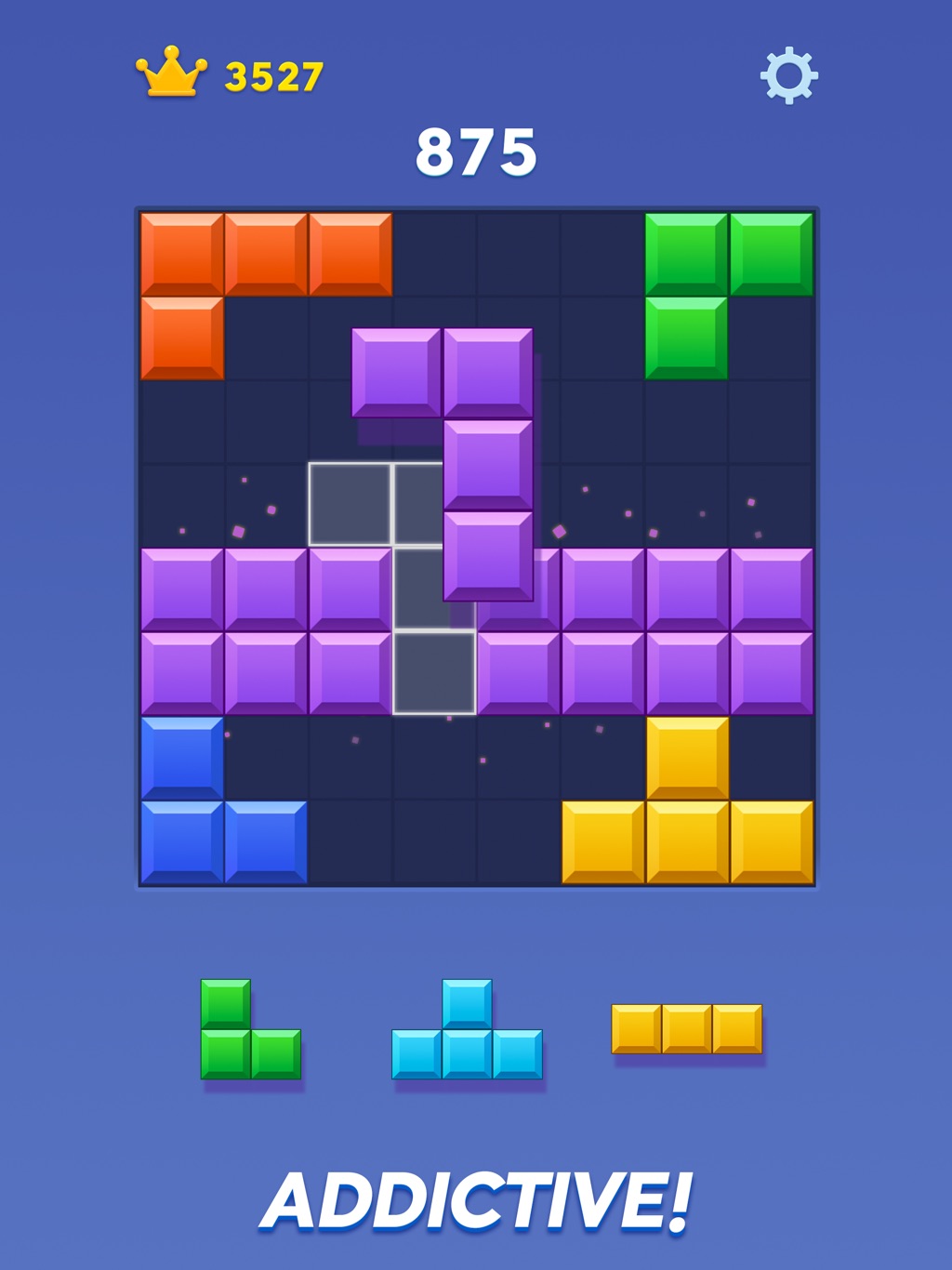
Publisher promotional artwork emphasizing a projected placement and line clear. It illustrates the presentation of an action, not a recorded scoring sequence or evidence of the game’s piece-selection algorithm.
The finger should carry the piece, not hide the answer
On a phone, direct manipulation brings a familiar problem: the thing you are moving sits under the thing you are moving it with. A visually obvious desktop placement can become uncertain when a finger covers the anchor and neighboring cells.
An original touch version can lift the piece above the contact point and show a preview on the board. But the relationship must remain stable. If the offset changes near an edge without a clear reason, the player may release over a different square than intended.
Separate invalid placement from strategic failure. If a piece cannot fit, keep it in the tray and show why. If it fits but blocks the next piece, accept the move and let the board communicate that consequence. The first is a control problem; the second may be the puzzle.
Our teaching model uses select-then-place buttons so the same task works with a pointer, touch, or keyboard. That is a choice for this article’s reader, not a claim that it reproduces the feel of dragging in Block Blast. When designing your own controls, compare alternatives with the actual device and hand position you expect people to use.
Ask a player to state their intended square before release. If the game chooses another, fix the interaction before adjusting puzzle difficulty. A puzzle should test a plan, not whether a finger happened to obscure the last column.
“Random” is not a complete puzzle design
The public rules we cite explain placement and clearing. They do not establish the exact piece-selection algorithm used in every version of Block Blast. A bad tray does not prove the system targeted the player. A fortunate tray does not prove it guarantees a solution.
For your own game, several generation policies are possible. Independent selection draws pieces without considering the board. A solvability check can choose a tray with at least one legal complete sequence. An authored challenge fixes both the board and pieces. A pacing system might choose among valid trays based on a stated difficulty measure. These are options to investigate, not claims about Hungry Studio’s implementation.
Even “solvable” needs a definition. Does each piece fit somewhere at the moment it appears? Can all pieces fit in some order? Can a human reasonably discover that order from the available information? The first condition does not imply the second, and the second does not imply the third.
Our trap opening illustrates the difference. The initial tray has a complete solution. A legal first move can still destroy it. If a generator guarantees a solution at the start, it has not necessarily promised to repair every later decision.
Write the intended promise before writing the generator. If players should always be able to finish through careful planning, validate that promise against complete sequences. If survival involves uncertain future draws, decide what information lets a player manage the risk, and make the role of uncertainty understandable.
Give the clear a little theatre, then give the board back
A clear deserves emphasis because it is a meaningful state change. Color, motion, and sound can identify the completed line and make a small action feel substantial. They become less useful when they conceal where the remaining pieces ended up.
For an original prototype, start with a brief highlight and a clean disappearance. Add one layer at a time. After each addition, ask someone to point at their next intended placement. If the answer becomes slower or less certain, check whether the effect is competing with the next decision.
Scoring creates another layer of value. A rule that rewards multiple simultaneous clears can encourage keeping nearly complete lines on the board. That creates tension: occupied space is a liability now and a possible bonus later. The exact scoring formula determines how attractive that trade becomes. We are describing a design option, not supplying an undocumented Block Blast formula.
Before adding a combo meter, decide what behavior it should invite. Planning intersecting clears is a different skill from maintaining a streak of frequent small clears. A single word, “combo,” can hide that difference from both the player and the designer.
Then test whether a player can explain a score change without opening a rules page. If they only know that sometimes the number gets huge, the effect may be exciting while the strategy remains inaccessible. That might suit your intended audience. It should be a choice.
A compact core still has a surrounding product
The official site presents multiple modes, including Classic and Adventure, and the Android listing discloses advertising and in-app purchases. These establish that the shipped product extends beyond the bare placement loop. They do not explain which feature caused its commercial performance.
For a small-team maker, separate the core experiment from the operating product. An enjoyable authored board does not yet test a long-session generator, tutorial, progression, content production, accessibility, or sustainable distribution. You can learn the spatial lesson without pretending you have reproduced the whole business.
Mode structure can also change the meaning of success. An endless score mode asks how long a board can stay useful. A finite challenge can ask whether you can satisfy one clear objective. The same placement rules support different stopping points and different feelings when a session ends.
If you add a rescue or extra attempt to your own puzzle, specify what it changes. Removing occupied squares, rerolling a tray, and undoing a move repair different problems. Each also changes what a final score means. Make the result understandable rather than burying that distinction inside an offer.
Begin with a complete, satisfying short session. Let someone finish or fail, understand the result, and leave. You can learn more from that clean boundary than from attaching several progression systems to a board nobody has yet enjoyed.
Make a puzzle that teaches its own mistake
The promising moment is a player returning to an earlier state and saying, “I need to save that corner for this piece.” They have moved from finding a fit to forming a plan. You now have something worth developing.
That is the transferable lesson in Block Blast: a small space can hold a long consequence. Give the player enough information to see it, enough control to act on it, and a board that makes the next question worth asking.
- Pick an original premise for arranging shapes: a sorting shelf, garden beds, stained glass, or a repair bench.
- Author one small board and one visible tray. Find a complete solution, then deliberately find a tempting move that closes it off.
- Offer undo while testing. Ask the player which earlier choice they want to change and why.
- Compare the same board with and without a placement preview. Keep pieces, scoring, and clearing rules identical.
- Record mistaken input separately from mistaken planning. Revise the control or the puzzle according to what you observed.
Sources & further reading
Official material and creator accounts behind this analysis. The interpretations, examples, and interactive models are Dashpop’s own.
Put your idea to work with the Dashpop Game Engine. Describe a game, play it quickly, and shape it yourself. Start with one change you can test.